Showing posts with label artificial stream. Show all posts

Monday, July 16, 2012

Week 6 Day 1

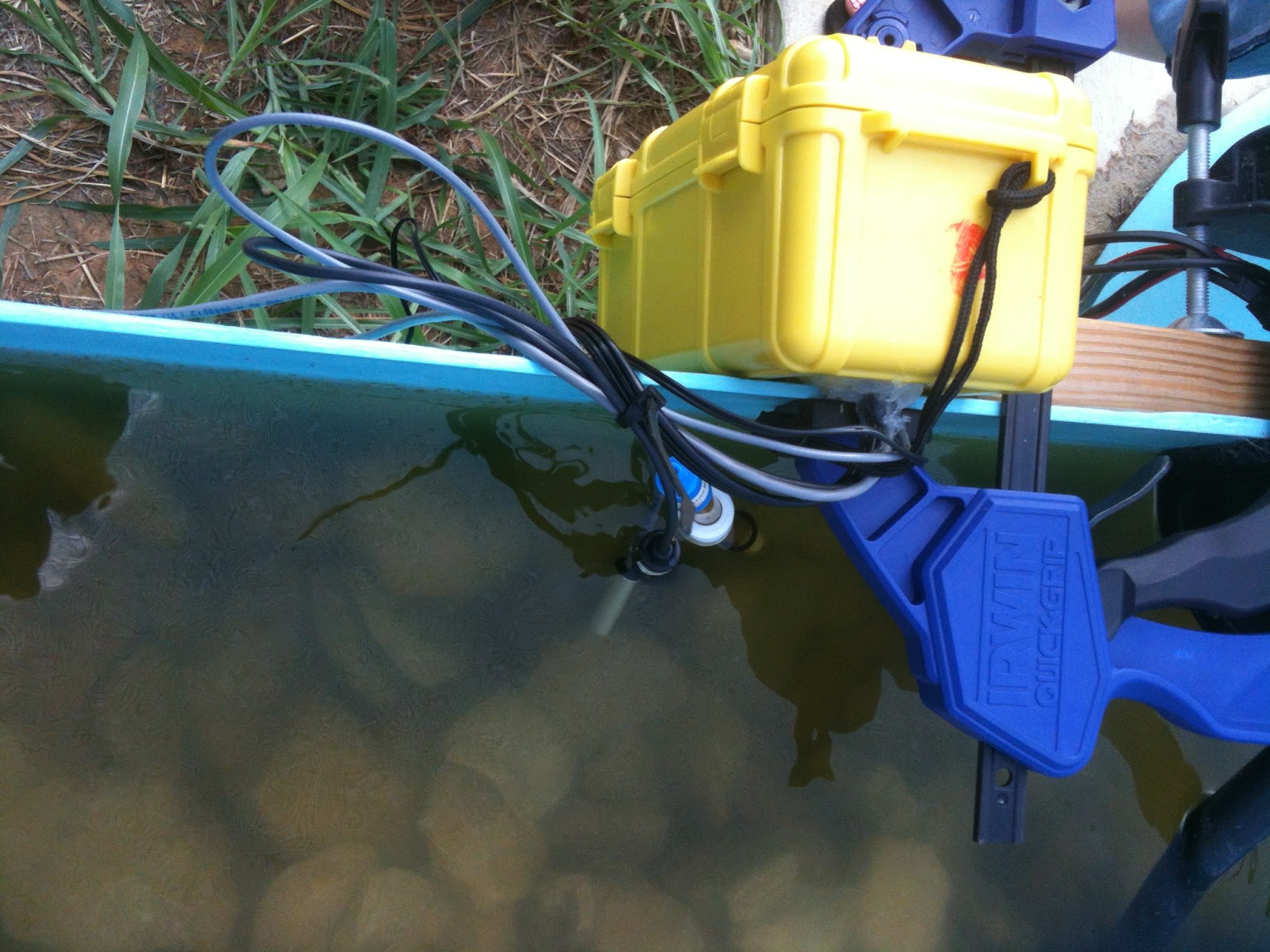
Today was another field day for use. We went out and met Dr. Hoenghaus and Luke at the Water Treatment Facility to set up our WSN and start logging data. We got our sensor cluster anchored and set up quickly.


We did take a second to calibrate the DO sensor, but it was pretty simple.


It took a little bit longer to get the YSI Sonde calibrated and set up. This time we used a more high end model that has a longer battery life and can stay in the field longer. It also has more ports for probes. This one is equipped with a pH, DO and temperature probe but also includes a turbidity probe.


The probe that Dr. Hoeinghaus is pointing at here is the Turbidity probe. The rollers are sponges that clean the probe so nothing gets caked on to the sensor. Once it was calibrated when dropped everything in the water together so we would have data that we could compare.


The original plan was to just log two hours of data and then bail. Luke and Dr Hoeinghaus planned on being at the facility all day today and tomorrow, though, and Yixing was ok leaving his computer over night so we made an executive decision in the field and decided to let the probes run until the morning. That is exciting because it increases the likelihood of getting changes in DO and pH since the temperature will almost certainly change. Since we are leaving things in the field we needed to set up the laptop somewhere protected. Putting it in the shed seemed like the best option but we were concerned about the signal. Joe set up an antennae on the wall of the shed with the lead heading through a small hole in the wall and Yixing set up his laptop inside.


The other big piece of news was that the camera is up and running, We rigged it up on a cross bar and accessed the signal using Yixing laptop and let Luke and Dr. H play. They were very excited by the possibilities.


Back on campus we had several more successes. I completed the activity we are going to use at TechFest and got approval from Joe and Lori while Joe made some great progress with the paper. Yixing also produced schematics for our circuit that we can include in our paper.

DO Circuit

Temp Circuit

pH Circuit
Power Circuit

Complete Circuit

That's not all, though. Yixing also created a website that automatically translates the data tables produced by the data sink into a visual format.


Pretty exciting stuff! Once we get the data from the sondes and the sensor cluster we can start checking to see how accurate our system is. We will keep you posted. If you are interested in an update on the fish in the artificial stream... sadly, we are down to 11. We had a couple of floaters this morning and most of the smaller fish are gone.

Friday, July 6, 2012

Week 4 Day 5

Today was sort of an all over the place day (Friday's seem to be like that.) We started off with a bit of a surprise when we counted the fish in our tank and realized 13 were missing. Joe pounced on that and did some research to see what might be going on. We had already ruled out them committing suicide (though it did occur to us recently that perhaps they were jumping out and a janitor was providing them a burial at sea) and the possibility of the pump pulping them. Here is what Joe came up with:

We made observations and took readings in our stream system this morning. Most fish congregated in tank 4. Beginning today we determined to take a count of the number of fish in each tank.


pHDOTemperature# of Fish
Tank 17.017.620.462
Tank 27.77.42.472
Tank 37.97.820.479
Tank 48.017.320.439


It took a while to count fish because they harbor in crevices between rocks. It helped to tap on the sides of tanks to “scare” them out. We counted 13 fewer fish than what we placed on Tuesday. We are baffled by the fewer number. After some quick research I found that minnows can tolerate a wide of temperatures but their preferred temperature range is 70 F- 90 F. http://www.co.washoe.nv.us/repository/files/4/v_gambusia.pdf

Gambusia Minnows “Mosquito Fish”
http://en.wikipedia.org/wiki/Gambusia_affinis


After all that we talked to Sharon and she said, "Maybe they big ones are just eating the little ones. They eat about their own body weight every day." Apparently we need to feed them more...


After that we got back to soldering. Joe kept working on his noise maker from yesterday and conquered the task.


While Joe was working on that Lori and Jennifer took a broken Simon Says game and a house made out of circuit boards and wired them up so that they had a solar powered house (I did a little cutting for them.)


This morning Yixin unveiled Circuit v4.0 for his where he simplified things a bit (still hyper-complicated) and I appreciate that because it means I don't have to hand wind transformers.


With that as my model I started the process of replicating that beast of a circuit four times.


Sadly, I didn't make it all that far. If you actually look at the circuit board that Yixin built you can see that there are actually 5 seperate circuits involved in the sensor cluster and we have just integrated them on to one board. What you see here is one of those circuits completed and replicated four times. It doesn't look like much but this took me most of the day to do. Granted, I am far from an expert. If you need more proof of that look at the last picture just above this paragraph and compare the solder tracks I made to the solder tracks in the completed sensor cluster Yixin slapped together in his spare time while eating a sandwich. *sigh*


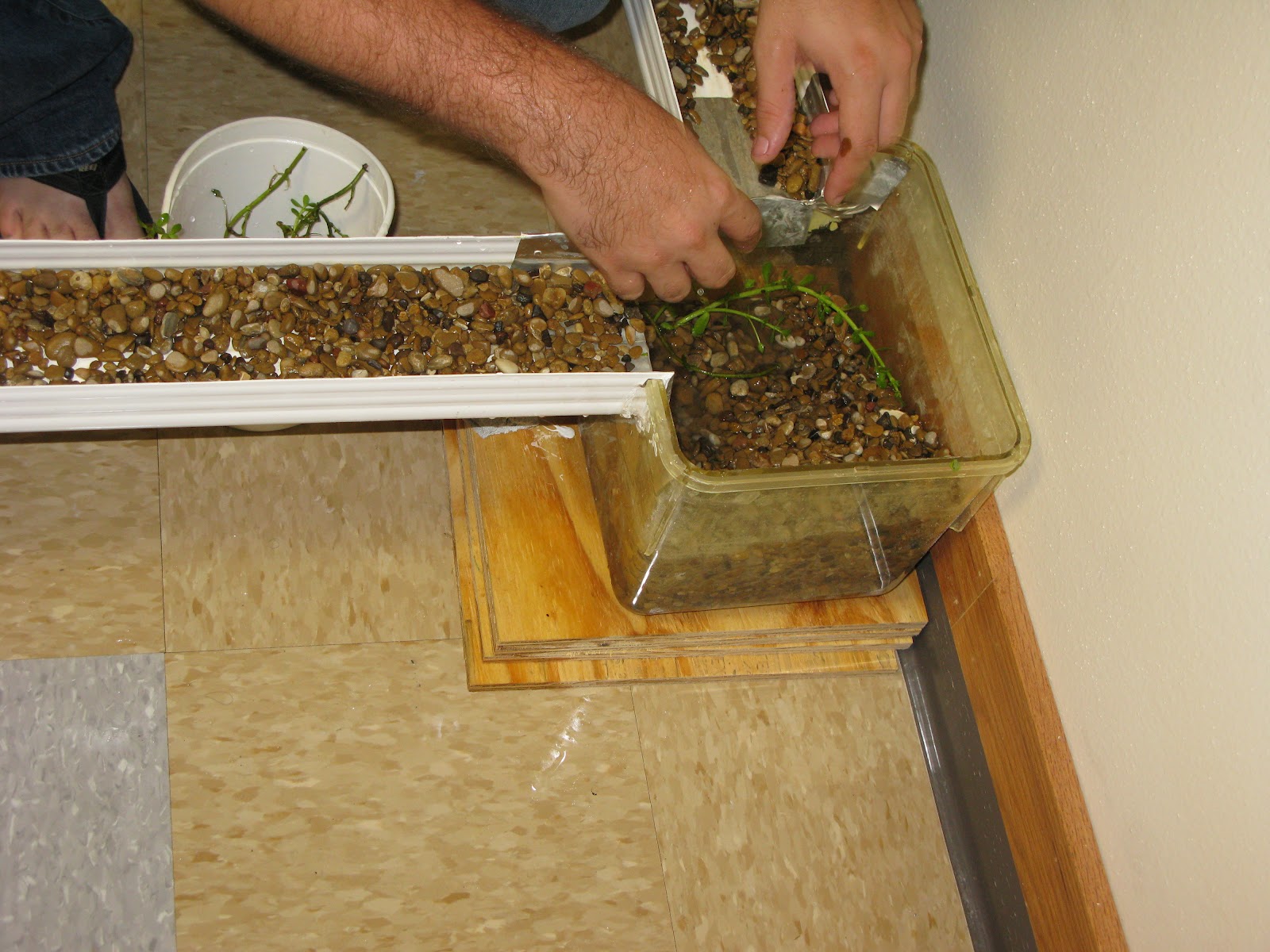
While we were sitting around the table soldering we were also discussing some changes we would like to make to the artificial stream when we replicate it in our classroom. One thing we want to do is get larger and deeper tubs so that we can vary the environment more and add a larger variety of fish. We were also thinking there might be a way to simplify the riffles by cutting down some of the accordion tubing that you connect to a gutter downspout and using that. It would have the ridges built in so you wouldn't need rocks and you could vary the size and number of ridges by expanding or shortening the tubing.

Future plans for stream riffle. This flex elbow will create riffles which would prevent having to add gravel to channels.
http://www.lowes.com/ProductDisplay?partNumber=137534-205-3708419&langId=-1&storeId=10151&productId=3012598&catalogId=10051&cmRelshp=rel&rel=nofollow&cId=PDIO1

Storage Bins that would work for tubs:
http://www.walmart.com/catalog/product.do?product_id=8282895&findingMethod=rr#Specifications

The mysterious case of the vanishing fish...

When we started up the artificial stream on Tuesday we initially loaded 35 fish. We have checked every day and not seen any floaters or dead fish on the bottom. We haven't seen any fish corpses on the ground around the tanks or the riffles. The pump has a micromesh filter and is buried under rocks so they couldn't have gotten pureed there. When we did a count today, though, there were only 22 fish in the tanks. There were four of us counting and we kept coming up with the same number. Odd. We will get back to you when we get to the bottom of this.

Thursday, July 5, 2012

Week 4 Day 4

This morning we had a  very interesting seminar from a gentleman named David who works for the City of Denton doing water quality. He is also a meteorologist for the Navy through the reserves. I will see if I can get his power point to share here.


After that Joe, Lori and I spent most of the day working with Jennifer to improve our soldering skills. We started out making a very simple circuit with an LED and a resistor.


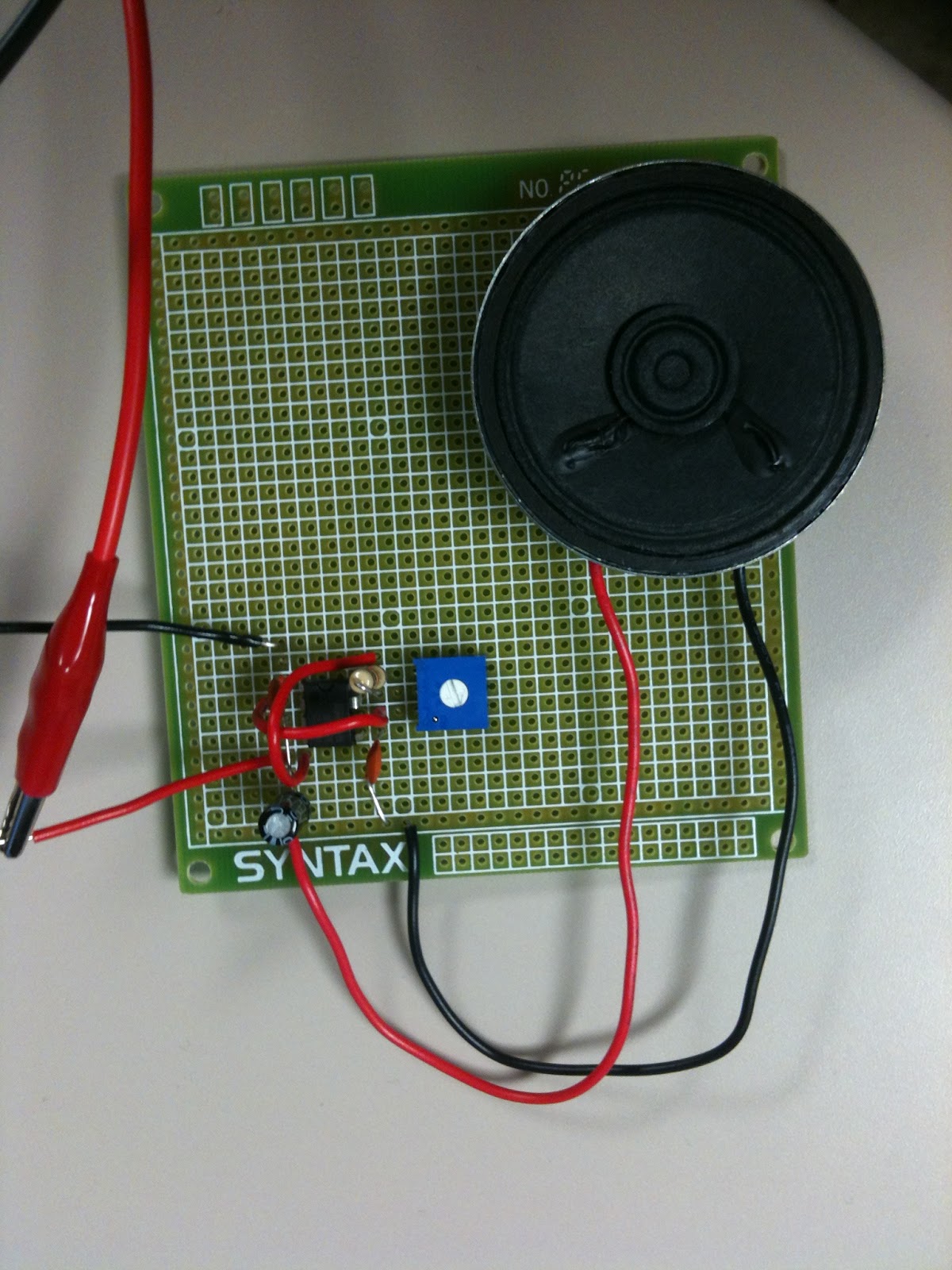
 After that we moved on and mapped out a noise maker circuit and put that together. Lori opted to make hers on a bread board and it turned out very well.


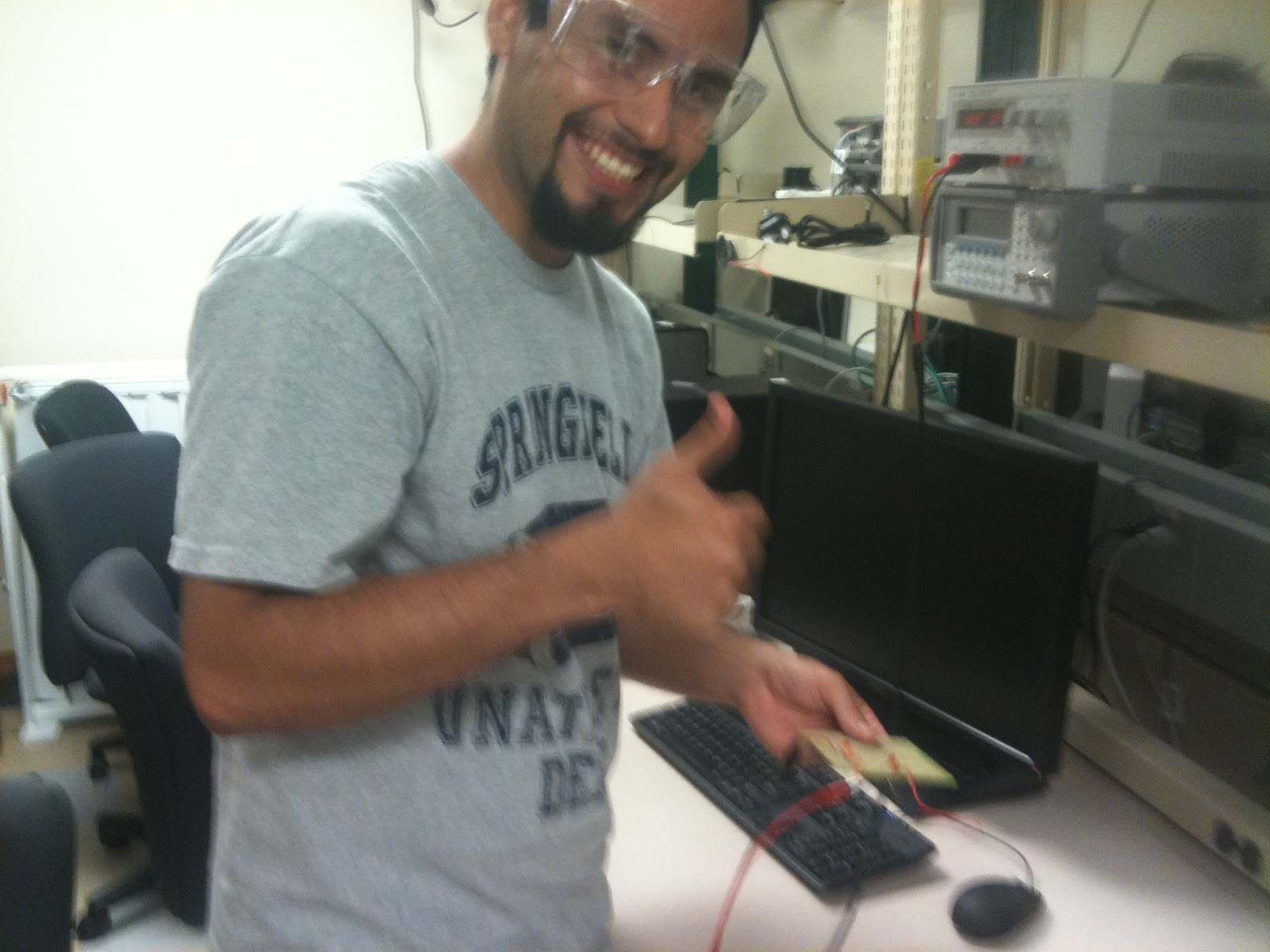
I went with the soldering option. Took a little longer but I am proud of the results. I just wish it was louder...


Lori and Joe have spearheaded accumulating some data from the sensors in the artificial stream. Here is what we have collected:

On Tuesday we managed to get our prototype stream system going with 15 minnows in tank 1 and 20 in tank 4. Zac added an equal distribution of plants to each of the tanks. Our gravel throughout spout created riffles large enough to increase oxygen levels. Fish migrated from tanks 4 to tank 3 and 2 but migration was limited in tank 1. We observed that tanks 2, 3, and 4 riffles have a higher volume of water allowing fish to travel upstream. In order to increase fish mobility between each of the tanks we created small channels in gravel.

Tuesday’s results- 2:30pm:
After setting up our stream we turned on the tank pump and bubbler and took probe readings after 1 hr. (allowing fish to acclimate to environment).
***note, Dr. Hoeinghaus brought his fancy YSI 600 to help us compare Spark to something professional grade. We measured our stream system and both pH and Temperature were spot on but DO measured higher- 10.


pHDO (mg/L)Temperature (C)
Tank 18.278.425.4
Tank 28.218.325.43
Tank 38.158.225.48
Tank 48.23823.32


Fish Behavior:
When we initially added fish to tanks we observed very little to no movement. After about 5-10 min fish began to move around. After 30 min we saw fish in groups of 3-4 move very slowly through riffles in tanks 4 to 3. Four would move halfway across, 3 would retreat, and only one would make it all the way through. Sharron predicted that the bigger minnows were pregnant females and interestingly enough we observed that they would stay closer to the floor of the tanks.

As we suspected, tank number 1, which has the bubbler hose, has the highest DO concentration decreasing in tanks 2, 3, then 4. pH was all over the place- no consistency. Tank 4, which has the pump motor seemed to have the lowest temperature. We turned off pump over our 4th of July break (a total of 36 hrs.) and took the following readings:

Thursday- 9:30am

pHDO (mg/L)Temperature (C)
Tank 18720.32
Tank 287.420.31
Tank 387.620.31
Tank 487.420.3


We observed that tank 3 has the highest concentration of plant matter and also higher DO. We suspect these are directly linked. Lori noted that lights were off during this period so photosynthesis would have decreased (although experiments show room lights have little influence on photosynthesis; the greatest contributor to photosynthesis is our sun) but cell respiration would have increased. We also observed tank 4 has the highest number of minnows. This again would yield a lower DO although minnows can gulp up air from the surface when exposed to harsh conditions.
Our next step will be to  measure again once the pump and bubbler have been on for two hours to compare data.

11:30am

pHDO (mg/L)Temperature (C)
Tank 17.867.820.1
Tank 27.97.220.14
Tank 37.97.720.09
Tank 47.97.320.05


As expected after running the pump for 2 hrs. DO levels rose in a couple of the tanks. Tank 1, which has bubbler, rose significantly +.8. Tank 2, -.2. Tank 3, +.1. And Tank 4, -.1. No consistency here. I think what’s happening is that fish are migrating from tank to tank which fluctuates DO levels. Also, Spark probes might not be giving accurate data.

2:30pm

pHDO (mg/L)Temperature (C)
Tank 18.077.520.12
Tank 28.037.420.07
Tank 38.037.120.07
Tank 487.720.08


Another set of data with varying numbers- no consistency. My next thought is volume of water affecting concentration of DO.

Tuesday, July 3, 2012

Week 4 Day 2

This morning we started out getting some things organized for our paper and pounding out some research. After that we went to two seminars. One was on robotic vision and that was not especially applicable to what we were working on. The first one, though, was explaining how you can use a UAV quadcopter as a tool in environmental surveys and research. Super cool. Also, if it wasn't for the FAA laws banning UAVs from commercial transactions this thing would make an awesome taco-copter.


I totally want one. After that we ran water through our artificial stream until it ran clear and then drained it as best we could. Then I situated the plants into the gravel and we filled it again. We treated the water and let it run for fifteen minutes. Once that was done Lori caught 15 fish and put them into tank one and then another 15 for tank 4. The thought there was we could see if the traveled upstream from tank 4 and see if they went down stream from tank one.


At first it didn't look like they were going to move much. We had one wash down the riffle from tank 1 to tank 2 right away and then another about a minute after. Then... nothing. They all went as deep as they could in their tank and stayed put. After a couple of hours, though, they started migrating. They will stay in one tank for a while and then one will get brave and head into a riffle. As soon as one does it four or five others will follow.


Once the artificial stream was in good shape we took another look at the circuit that Yixin had been perfecting. It now works exactly the way we want it to but it has gotten much more complex.


We are going to have to make four more of these bad boys so I sat down with Yixin and we started putting together the power controller for the sensor clusters. This is a lot more complicated then I expected and started out with Yixin making me wind coil for our DC transformers. Each transformer has two coils. The inner coil is wound 50 times with copper wire and the outer coil has 102. I made two of those today. I still have six more to go. After those were done we started laying out the circuit. Once I got a power controller set up completely on one of the boards we flipped it and Yixin told me to start soldering. I had a mild panic attack. Jennifer noticed and we started a soldering 101 refresher course. I made a couple of decent lines before I started screwing up. After that Joe jumped in and we started taking turns. By the time I stopped for the afternoon I was able to make two parallel tracks six spaces long with no bleed over or yellowing and Joe was getting close. After that we started talking about simple motors since we had copper wire laying around and I showed them one I made with my physics students.


While I was doing the electronics part, Lori and Joe were working with Dr. Hoeinghaus on the sensors, including setting up a YSI and giving him a run down on the artificial stream.